




Physicians often spend hours on administrative tasks, research, and content creation that could be partially automated with the help of artificial intelligence (AI). During a presentation Thursday at the 2026 American Glaucoma Society (AGS) meeting in Rancho Mirage, California, James T. Murphy, MD, suggested that before embarking on time-consuming professional tasks, physicians should pause to consider, “If I’m going to spend any amount of time doing this [activity], is it something that could be automated or done more efficiently using an AI tool or agent?”
Dr. Murphy, a refractive cataract and interventional glaucoma specialist practicing in New York and Connecticut, focused on accessible approaches for clinicians who have limited prior experience with AI. His presentation, titled “AI Now: A Roadmap for Using AI Today,” outlined practical strategies for deploying real-world AI in clinical practice, emphasizing tools that could immediately enhance productivity in clinical, surgical, research, and business aspects of ophthalmology.
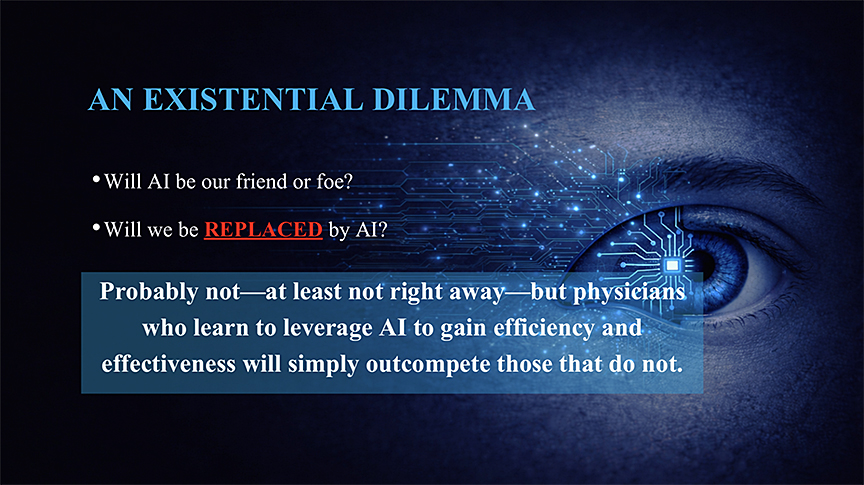
To provide context, Dr. Murphy briefly traced the history of AI, noting that its origins stretch back decades. “AI has been around a surprisingly long time,” he said, with early development dating to the 1970s. What has changed is the widespread commercial availability of natural language processing tools, beginning with the release of ChatGPT in 2022. Over the past few years, these AI-powered tools have evolved into agentic AI systems that can plan, act, and execute complex multistep tasks with little or no human supervision, rather than being limited to prompt-and-output responses.
Bringing AI Into the Clinic
Dr. Murphy noted that his use of AI tools is a response to broader systemic challenges in health care, where high costs often have little to do with direct patient care. “Around 75% of the cost of US health care is driven by administrative red tape,” he said. “So, the question becomes: how do we automate or eliminate as many of these administrative burdens as possible?”
He highlighted several of his AI-related projects from 2025 as examples of ideas glaucoma specialists could consider to improve their practice efficiency. One focus was clinical documentation. After experimenting in the past with in-person scribes, remote scribes, and early-generation AI scribes that required frequent manual interaction, in 2025 he beta-tested a more frictionless AI scribe that was better integrated into his electronic medical record (EMR) system, required less direct interaction, and could handle complex dictation tasks involving multiple speakers and languages. “Non-AI solutions were just not very good, and still relied on human power,” he said. “The more integrated AI scribe worked surprisingly well for being a first try.”
AI can also assist with research proposal composition. “Writing a well-researched proposal takes weeks or months, but with AI you can generate a full literature search and reference list in a couple of minutes,” explained Dr. Murphy. He also described using AI to generate presentation graphics and educational content for patients, including videos that featured an AI-generated avatar.
A more unconventional application involved reconfiguring his office to improve workflow efficiency. Rather than hiring a consultant, Dr. Murphy put information about the space—such as room dimensions and office layout—into an AI program and asked it to analyze how his practice would function best. “We reconfigured a lot of the rooms and even adjusted where the diagnostic equipment was placed within rooms to optimize workflow,” he said. “It’s worked really well and cost nothing but my time to have a conversation about the sticking points with ChatGPT.”
Future Directions
Looking ahead to 2026, Dr. Murphy outlined several planned projects, including testing an AI scribe that is “highly integrated” with his EMR system and developing a suite of AI agents to support administrative and professional tasks. He also described his plans to automate website maintenance and search engine optimization—tasks that are often outsourced to paid consultants. “There’s no sense in having humans do any of that if AI can do it better for free,” he said.
Dr. Murphy also plans to explore limited clinical applications this year, including testing the ability of AI to assist with intraocular lens selection for cataract surgery. He emphasized that these efforts would be exploratory, comparing AI-generated recommendations against traditional methods. “This is more about seeing whether AI can pick lenses accurately based on the same data I use,” he said, “and comparing it directly to what I would have chosen.”
The presentation included a demonstration of basic AI customization, as Dr. Murphy showed attendees how to tailor large language models to their own preferences, as well as an overview of existing tools for clinical decision support. Dr. Murphy cited examples such as Open Evidence, an AI-powered clinical decision support platform and medical search tool, and Zeiss’s Veracity platform. He also mentioned several recent health-focused AI initiatives, including a partnership between Open AI and Thrive Health. “The machines have got their eyes on healthcare,” he said.
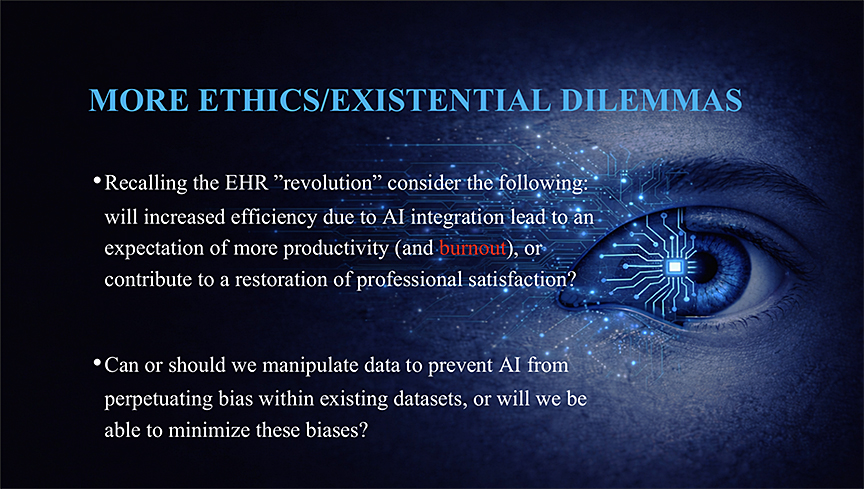
Dr. Murphy concluded by encouraging clinicians to adopt AI in ways that improve efficiency while remaining mindful of limitations and ethical responsibilities. “How do we make ourselves better, more efficient, and more effective physicians?” he asked. “We have to automate and eliminate a lot of those administrative tasks that are so costly, without compromising care and probably improving it.” GP