





Modifiers on claims provide additional information about the service or procedure performed. They are used to alter or “modify” a CPT code without changing the code or its definition. Modifier -24 indicates “Unrelated evaluation and management services by the same physician or other qualified health care professional during a postoperative period.” According to CPT guidance, “The physician or other qualified health care professional may need to indicate that an evaluation and management service was performed during a postoperative period for a reason(s) unrelated to the original procedure.”1
Modifier -24 applies to exams within 10-day and 90-day postoperative periods. Although “evaluation and management services” generally refers to CPT codes 99202 and higher, modifier -24 may also be applied to general ophthalmological services (920xx). It does not apply to diagnostic tests or additional procedures.
Group Practice Considerations
Physicians in a group practice are considered extensions of one another. Medicare treats physicians in the same specialty within the same group as the “same physician.”2 Therefore, if modifier -24 applies to a service provided by one ophthalmic surgeon, it should be applied similarly when another ophthalmologist in the group provides a service for the same patient. For example, modifier -24 applies when a glaucoma specialist sees a patient for preexisting open-angle glaucoma 4 weeks after cataract surgery performed by her partner. Conversely, modifier -24 does not apply when an ophthalmologist covers for her vacationing partner and sees a patient for a routine postoperative visit 11 weeks after cataract surgery.
Within the Medicare program, ophthalmologists’ claims include modifier -24 in approximately 2% of office visits, while optometrists use it in about 1% of office visits. Modifier -24 is relatively uncommon because most postoperative visits are not billed. However, inappropriate use can be problematic. The Office of Inspector General has reported questionable billing associated with providers who bill unusually high rates for ophthalmology services using modifiers.3 In our practice, we find that the term “unrelated” is interpreted inconsistently, so that this modifier is sometimes applied inappropriately.
Defining “Unrelated”
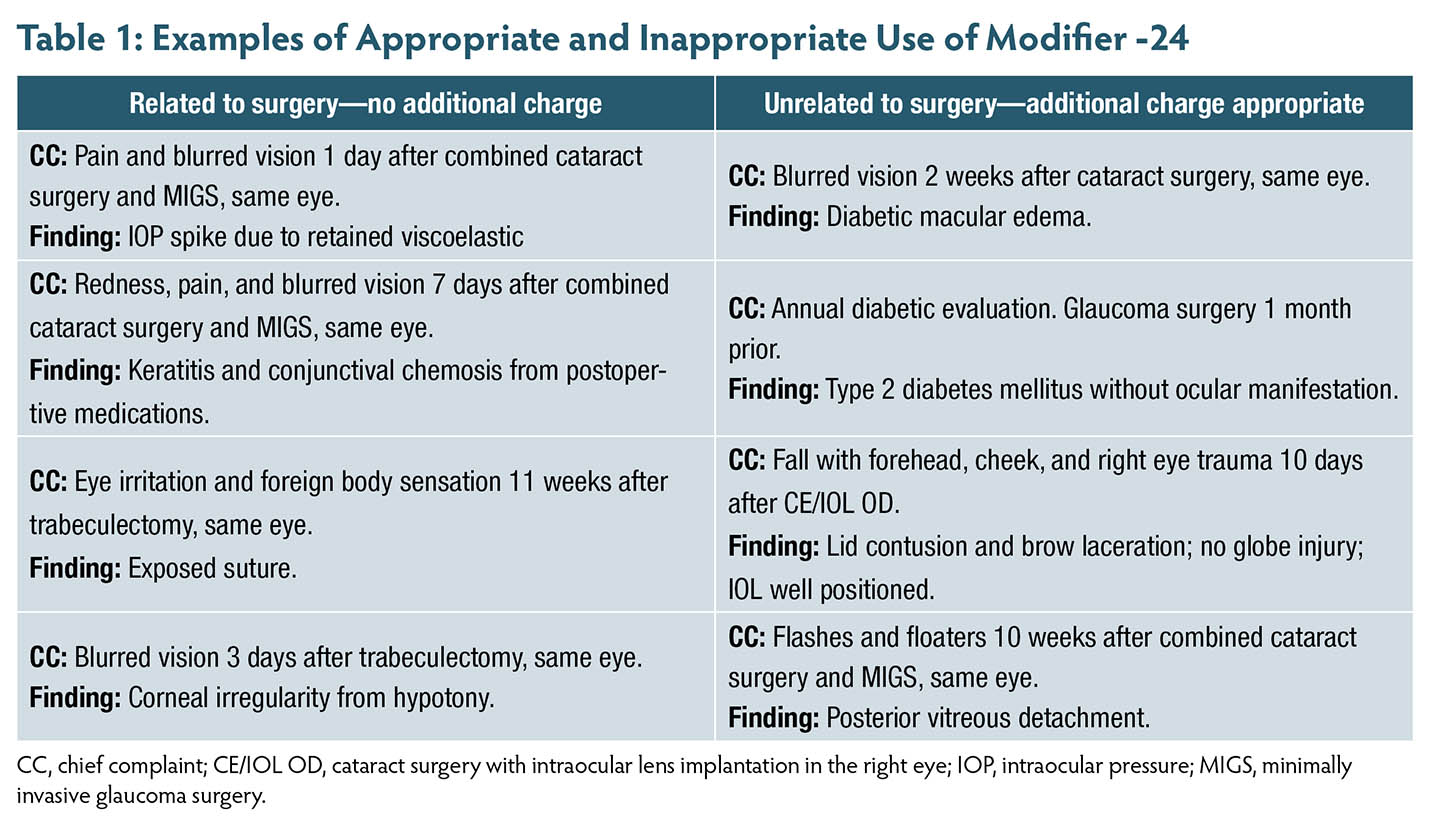
For billing purposes, “unrelated” refers to a problem or condition that is not connected to the surgery in any way. It is not a surgical complication or adverse event, nor is it typical follow-up care to monitor recovery. Modifier -24 may be applied to preexisting conditions independent of the surgery or to conditions in the unoperated eye. Several publications provide additional guidance on this topic.4-6 Table 1 provides some examples that can illustrate this concept.
Cataract Surgery and Modifier -24
In the context of cataract surgery, should modifier -24 be used for an eye exam following the initial operation to determine the need for surgery in the fellow eye? Sometimes. When patients present with cataract symptoms, ophthalmologists typically evaluate both eyes. The patients often satisfy the criteria for surgery in both eyes. Cataract surgery is almost always performed sequentially, and payor policies generally require documentation confirming the need prior to the second procedure. The outcome of the first surgery cannot be predicted and may influence the plan for the contralateral eye.7
The medical necessity for each surgical procedure requires sequential evaluations and discrete documentation in the medical record. For many patients, if cataract is the only diagnosis, a brief exam between procedures may reveal nothing new beyond the initial preoperative evaluation. Such an exam is not separately billable. However, if the exam identifies new concerns since the initial surgery, or an unexpected outcome of the procedure, then it does not duplicate the earlier examination and should be billed. If this exam occurs during the global period for the first eye surgery, the medical record must clearly document that the visit addresses a billable, unrelated condition, not routine postoperative care for the initial surgery.
Palmetto GBA, a Medicare Administrative Contractor (MAC), notes: “If assessment for surgery on the second eye is performed after assessment for surgery on the first eye, this may be a compensable service even if performed in the global period of the first eye since it is separate and additional work to postoperative evaluation of the operated eye. However, this A/B MAC would consider the need for a separate service to be rare and must be justified with documentation. If the decision to perform cataract extraction in both eyes is made prior to the first (sequential) cataract extraction, the documentation must support the medical necessity for each procedure to be performed.”8
Key Points
To avoid claim denials or audits, keep these essential considerations in mind when using modifier -24:
- Modifier -24 is infrequently used with evaluation and management services during the postoperative period.
- Modifier -24 is appended to E/M or eye codes, not to diagnostic procedures.
- Physicians in the same specialty within a group practice are considered extensions of one another.
- The office visit must address an unrelated condition or problem, and the chart should document this clearly. GP

References
1. American Medical Association. CPT 2026 Professional Edition. American Medical Association; 2025.
2. Centers for Medicare and Medicaid Services. Medicare Claims Processing Manual Chapter 12 §30.6.5 Physicians in Group Practice. December 19, 2024. Accessed January 29, 2026. https://www.cms.gov/Regulations-and-Guidance/Guidance/Manuals/Downloads/clm104c12.pdf
3. Department of Health and Human Services, Office of the Inspector General. Questionable billing for Medicare ophthalmology services. September 2015. Accessed January 29, 2026. https://oig.hhs.gov/oei/reports/oei-04-12-00280.pdf
4. Wilcox A. What is modifier 24 and when do you use it? Find-A-Code. Accessed January 29, 2026. https://www.findacode.com/articles/what-is-modifier-24-when-do-you-use-it.html
5. Novitas Solutions. Modifier 24 fact sheet. July 31, 2023. Accessed January 29, 2026. https://www.novitas-solutions.com/webcenter/portal/MedicareJH/pagebyid?contentId=00101583
6. Palmetto GBA. CPT modifier 24. February 14, 2023. Accessed January 29, 2026. https://www.palmettogba.com/palmetto/jmb.nsf/DIDC/8EEL8Z8475~Claims~Modifier%20Lookup
7. AAO Preferred Practice Patterns. Cataract in the adult eye PPP 2021. November 2021. Accessed January 29, 2026. https://www.aao.org/education/preferred-practice-pattern/cataract-in-adult-eye-ppp-2021-in-press
8. Palmetto GBA. Local coverage determination L34413: cataract surgery. November 21, 2024. Accessed January 29, 2026. https://www.cms.gov/medicare-coverage-database/view/lcd.aspx?lcdid=34413&ver=53&bc=0